Tsingley defines a smart device not as one with sensors bolted on, but as a two-phase digital leap: pre-ship (edge controller, data pipeline, baseline health model) and post-ship (train the process model on real production data). The result is a device that can see, tell good from bad, and keep learning. We show how ultrasonic welding becomes process-aware via three-path fusion.
One-line overview
In manufacturing, "equipment intelligence" is too often reduced to "add a few sensors and put it on the cloud." In Tsingley's methodology, that is barely the beginning. A truly smart device evolves from "can collect data" to "understands the process": it not only sees parameters, but tells good from bad and keeps learning from production. We split this path into a pre-ship and a post-ship phase that together form a closed loop.
1. How we define a "smart device"
Tsingley does not define an IoT smart device as "networking an old machine." We define it as a two-phase digital leap:
- Pre-ship (R&D / design view): pre-install digital capability — edge controller, sensors, data pipeline, baseline health-model framework.
- Post-ship (field / O&M view): train the device to understand the process in the real production environment — assess quality, maintain remotely, tune the model on real data.
The key insight: pre-ship is not "finishing everything," it is "building the framework." Real process understanding only begins when the device enters the customer's line.
2. Pre-ship: pre-install digital capability into the device
Pre-ship delivers six concrete things that together form the device's digital base:
- Install Tsingley's edge-computing controller, putting compute next to the machine;
- Integrate necessary sensors and peripherals (barcode scanner, current transformer, etc.);
- Implement device data acquisition, analysis and processing;
- Build mathematical models for health score and OEE;
- Connect to upper systems (MES, ERP) with zero code;
- Customize an intelligent HMI, and reserve a process-model training interface to be activated post-ship.
The output is a device that "ships with digital capability": pipelines live, models exist, UI exists — but it still does not know what the customer's process actually looks like.
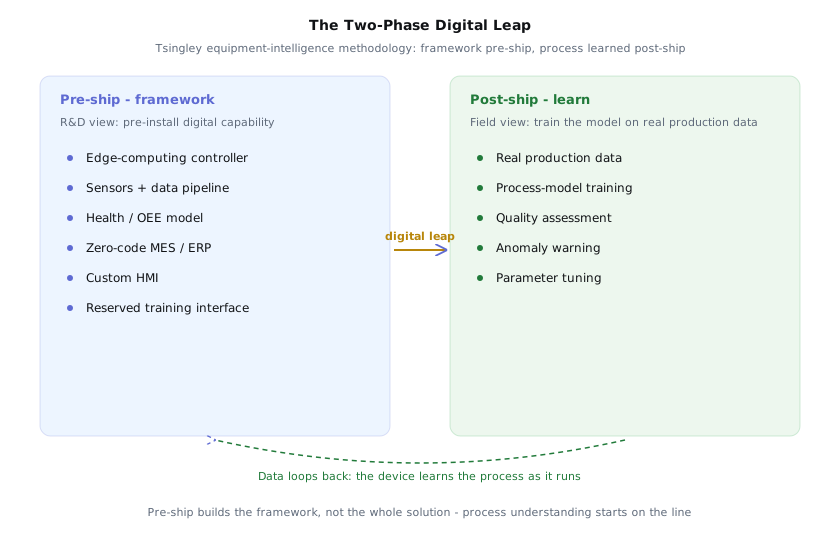
Pre-ship installs the framework; post-ship keeps training on real production data.
3. Post-ship: let the device learn the process on the real line
Once delivered to the customer site, the device enters phase two. Real production data flows back and the device starts learning:
- Real production data → process-model training;
- Process-quality assessment, giving pass / fail judgment;
- Anomaly detection and early warning, stopping faults before downtime;
- Model-parameter tuning, feeding back to data acquisition to close the loop.
This is a loop that runs continuously: the device understands the process better the more it is used, instead of "peaking at shipment and only aging afterward."
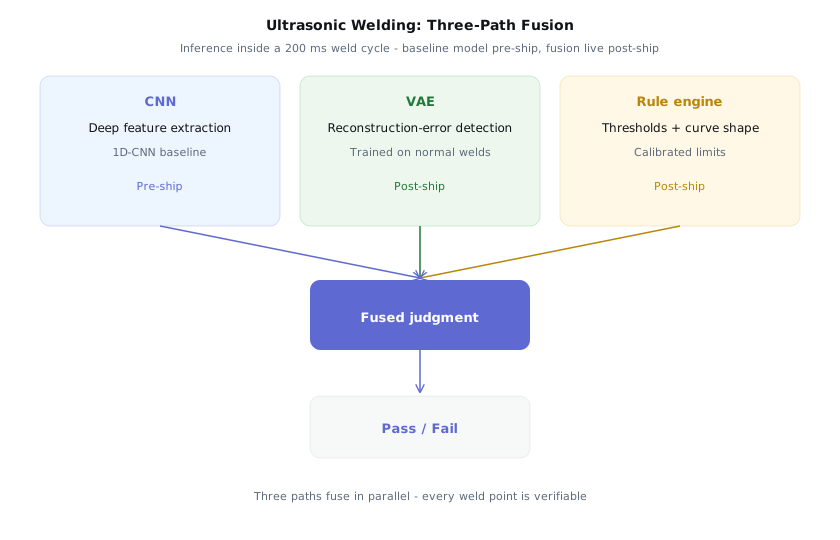
CNN, VAE and the rule engine fuse in parallel into a traceable quality judgment.
4. What "understands the process" really means — three layers
We break "process-aware" into three layers, each backed by a Tsingley product:
- See it: process parameters visible in real time (power curve, temperature trend) — carried by the ONLINE dashboard and MES-LINE live board;
- Tell it: distinguish normal from abnormal states — carried by CNN + VAE + rule-engine three-path fusion;
- Learn it: continuously improve the process model from production data — Human-in-the-loop labeling, retraining, model evolution.
Stack the three and you get complete "intelligence"; miss one and you only get half-baked digitalization.
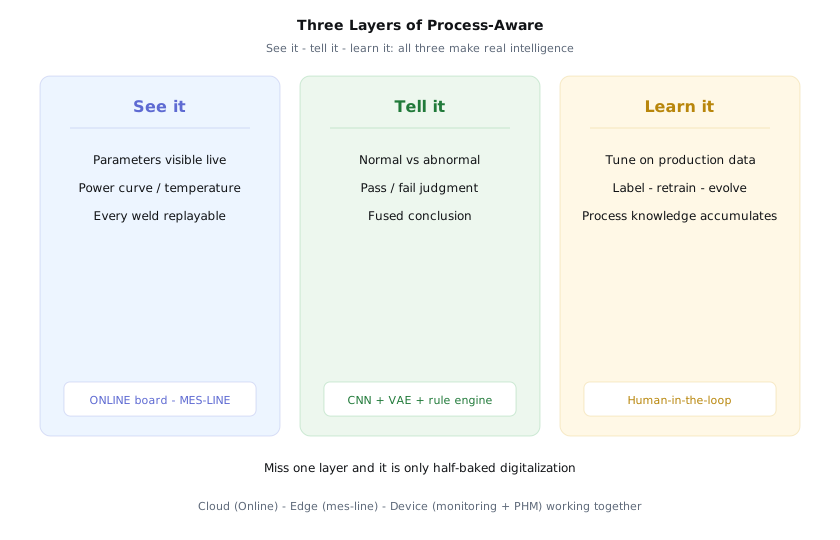
See it, tell it, learn it - all three layers make a process-aware device.
5. A real case: ultrasonic welding
Ultrasonic welding is a perfect sample of this methodology:
- Pre-ship: edge controller + power / amplitude / frequency sensors + a 1D-CNN baseline model — the device can already "collect";
- Post-ship: on-site weld data → VAE trained on normal samples → rule engine calibrates process thresholds → three-path fusion goes live;
- Result: the device evolves from "can collect" to "understands the process" — it knows what a good weld is and what a defective one is; every weld point is verifiable.
This is the core of Tsingley's inline-monitoring system, and the concrete form of the "equipment-intelligence methodology" on the production line.
6. Closing: smart equipment is a start, not an end
Many factories treat "networking the equipment" as the finish line of digitalization. To us it is only the start: networking solves "see it," but the real value is in "tell it" and "learn it." Tsingley's methodology pre-installs the framework pre-ship and keeps training post-ship, turning a "block of iron" into a smart device that speaks, self-diagnoses, and keeps evolving.