Field notes from a real FDE engagement: the customer never asked for AI and had never heard of FDEs — they simply bought mes-line, our line-control system. Because mes-line ships with MCP support, AI came through the door with the product: when they added a KEYENCE device on the fly, AI pinned down the register values and had it collecting data the same day — faster than waiting for a point list. The brain is summoned from the cloud to work on-site, while production data never leaves the factory.
The Short Version
The customer bought mes-line; AI hitched a ride through the door. These field notes come from an on-site engagement at a micromotor factory: no AI requirements, no notion of FDEs — just “tell us what you need, and we’ll show it to you right here” — plus one question the customer kept asking: “will our data end up on the internet?”
What Is an FDE, and Why the Customer Never Said the Word
FDE stands for Forward Deployed Engineer: the person who takes the product to the customer’s site and makes it work in the real environment. The term comes from Silicon Valley and has gained traction as AI moves into production — because an AI product’s value depends heavily on on-site context that no office-bound team can fully imagine. Someone has to be there, embedding the product into the customer’s operation.
Writing this, I realized something: the customer never once said the word “FDE.”
They didn’t know what an FDE was, and honestly, not much about AI either. Not one requirement they raised contained the letters “AI.” On the purchase list was one thing: mes-line — a line-control system for equipment, data acquisition, and traceability. This is a globally known micromotor manufacturer running real delivery pressure on its lines. What they wanted was a system that works, not a concept.
So how did AI get in? In hindsight, it’s simple: mes-line ships with full MCP support; MCP lets AI plug in; AI walked in with the product. The customer bought a product, and AI came along for the ride.
That may be exactly how AI actually enters manufacturing: don’t sell the AI concept — hide the capability inside the thing the customer already wants.
On-Site: They Ask, We Show, Right There
The moment most worth recording happened during data acquisition.
The customer asked, on the fly, to add a KEYENCE device to the line. The old playbook would have meant a round trip: the customer carves out time to compile a point list — register addresses, data formats — hands it over, and we develop against it. Waiting for that list alone eats a chunk of schedule.
This time there was no wait. AI went straight in: pinned down the register values, generated the integration config, and hooked into mes-line’s device layer. The device was collecting data that same day. The whole thing moved faster than the customer producing a point list.
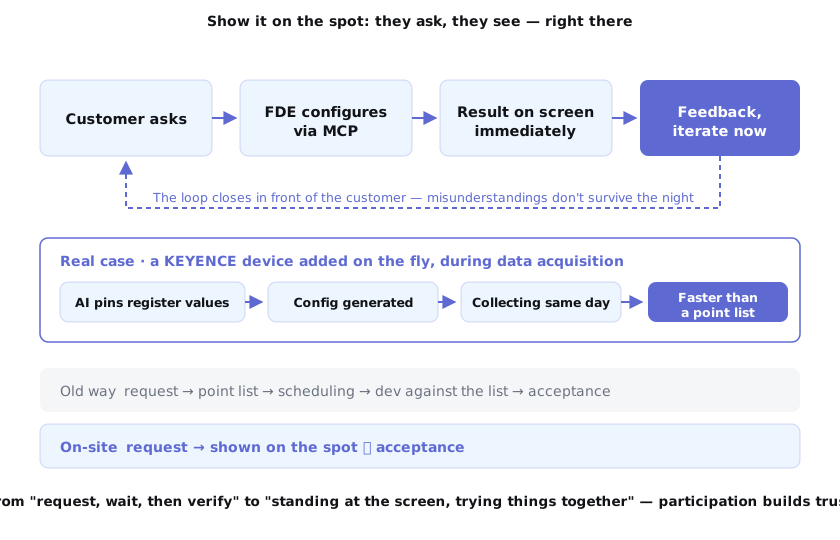
The bigger shift was in the room. The 106 MCP tools across 11 domains (numbers from our previous release post) are not just our implementation tooling — with the configuration panel open, the customer’s engineers could watch and change things themselves. A customer would voice a need, we’d configure it with MCP on the spot, and the screen would show the result immediately. Participation changed shape: from “request, wait for a slot, then acceptance testing” to “standing at the screen, trying things together.”
Does deep customer involvement create chaos? Quite the opposite. Showing it on the spot collapses requirement confirmation and acceptance into one step. Misunderstandings surface and get fixed right there — far cheaper than discovering them in a document two weeks later.
“AI does the work; a human pulls the trigger” — that line came from the previous story in this series. On-site, we learned the trigger has more fingers on it than we thought: the customer’s engineers were pulling too.
“Will the Data Leave the Factory?” — The Hardest Question on Site
The speed excited the customer, but trust had its own gate. One question kept coming back: could this data leak? Would anything be uploaded to the internet?
A fair question. Production data is the lifeblood of a manufacturer — capacity, yield, process parameters. None of it belongs on someone else’s server.
Our answer was a metaphor: the brain lives in the cloud, and what we do is summon that brain to work on-site — but nothing from the shop floor leaves with it.
In precise terms: mes-line and Online run on the customer’s own premises, and production and business data stay in the customer’s own systems. On the AI side, what crosses the wire is a reasoning request going out and an execution instruction coming back; the work itself is done locally by the on-site system. What travels is a “request for an answer,” not a “database.”
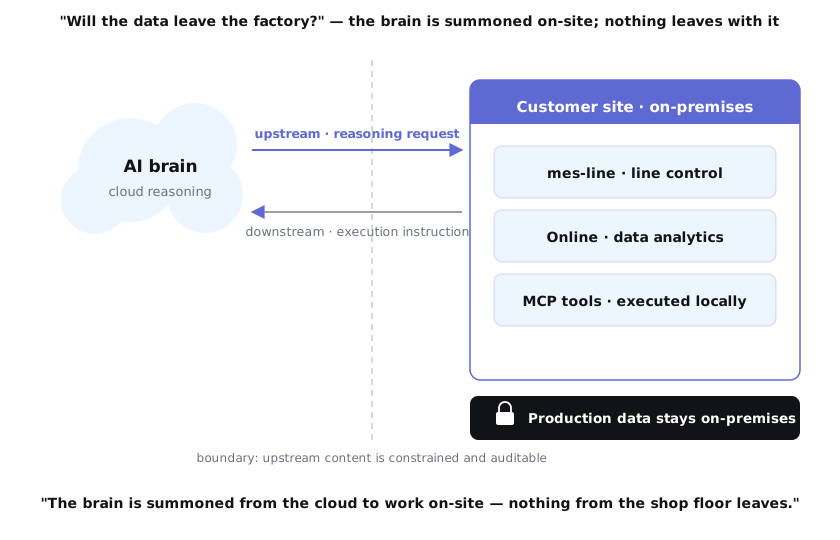
The boundary deserves precision too: this route only works when what goes upstream is constrained and auditable. What may leave, and what never does, should be agreed with the customer in writing before work starts. Which is the other lesson of this trip: have the security answer ready before the customer asks.
What the Engagement Taught Us: A Working FDE Playbook
Laid out, the on-site practice distilled into four disciplines:
| Discipline | In one line |
|---|---|
| Show it on the spot | They ask, you build, right there — confirmation is acceptance; misunderstandings don’t survive the night |
| Read-only by default | Every line-side access starts read-only; writes only with explicit, per-action customer approval |
| Security answer first | Know where the data goes before day one; never improvise an answer to that question |
| Participatory configuration | Hand part of “change the system” to the customer via MCP and the config panel — participation builds trust |
And the less glamorous part: showing things on the spot did not eliminate leftover problems. After the fast on-site delivery, the punch list was still long.
But the nature of the problems changed. Traditional engagements accumulate “directional rework” — the kind that hurts to undo. What this one left behind was “targeted quick fixes”: every item knew what to change and why. That’s no coincidence — requirements validated on the spot burn off the directional errors early, leaving only details.
Closing Note
Back to the title: the customer never asked for AI, yet AI entered the factory.
The purchase order named one thing, mes-line. But because mes-line ships MCP as a standard capability, AI was inside the product as it crossed the gate — and the work was getting done before anyone pointed at it and said “that’s AI.”
The day the customer starts asking “could AI also do that?” is the day the barrier is gone. We’re betting on this route — and we’ll keep writing these field notes, one engagement at a time.