In GPT-6-Astra's sim2real study, machine-readable geometry and synchronized experience cut task time 57.4% and 68.6% with weights fixed; real-robot reuse cut 53.0% and 49.9%. NVIDIA's simulated automotive assembly and Xiaomi's 100K hours of UMI data point the same way: a model's ceiling is its world description. Tsingley ONLINE is that description for a factory — a production ontology built for models, with three-loop coupling defining the relations.
One-line overview
Three stories — GPT-6-Astra's sim2real paper, NVIDIA moving automotive assembly into Isaac Sim, and Xiaomi training a robot foundation model on 100K hours of human manipulation data — look like robotics news. They are really about one thing: a model's ceiling is set by how completely we describe its world. In a factory that description is an ontology. Tsingley ONLINE is software built for that ontology: not just dashboards for people, but a structure a model can read — which plant, when, which line, which machine, what was done, what came out, and where the loss landed — so a request in plain language can be reasoned over directly.
1. Names and evidence first
GPT Astra here refers to the general-purpose multimodal agent called GPT-6-Astra (or GPT Astra) in the public literature. The primary source for its sim2real results is arXiv:2609.31770, submitted 24 September 2026. Stanford's The Movement Lab and Caltech also published HomeBody, wiring a comparable model to a Unitree G1 with a Real2Sim twin in Isaac Sim — but its public material reports no quantitative success rate, so this article treats it as an architectural reference only and quotes no numbers from it.
Every external figure below comes from the papers, NVIDIA's own site, or Xiaomi Robotics' project page; full links are in References. Where we draw our own conclusion, we say so explicitly. Manufacturing writing goes wrong when demos are reported as deployments and second-hand summaries as data.
What sim2real actually solves
Sim2real asks whether something learned in simulation works on real hardware. Real-world trials are slow, expensive and risky; simulation is cheap, but never perfectly faithful. Closing that gap turns out to depend less on a bigger model than on more accurate descriptions and better-recorded experience — the starting point for everything below.
2. Astra's sim2real: what mattered was a machine-readable body
arXiv:2609.31770 uses a dual-arm XLeRobot on an elevator-button task. The decisive design choice: model weights stayed fixed and every trial started a fresh session — no new policy was trained. Researchers only varied what the agent was given: from a common control API, joint names and feedback, up through mechanical XML, meshes, camera mounting, and synchronized image/action/state records of one successful attempt.
Reported results (means, from the abstract and paper):
| Condition | Trials | Change vs baseline |
|---|---|---|
| Complete geometry and camera data | 30 fixed-start sim | mean time -57.4% |
| Synchronized image + action + state | 30 fixed-start sim | -68.6% |
| Reuse experience, start shifted 10-100 cm | 9 pairs / 18 trials | -58 to -63% |
| Agent-generated feedback routine, refactored | 27 sim trials | local task time -29 to -31% |
| Real robot: sim XML / sim experience | 12 real trials | -53.0% / -49.9% |
The paper also records Astra parsing XML, computing coordinate transforms and forward kinematics, and inspecting gripper meshes to find a viable approach pose. It turned machine-readable description into executable action.
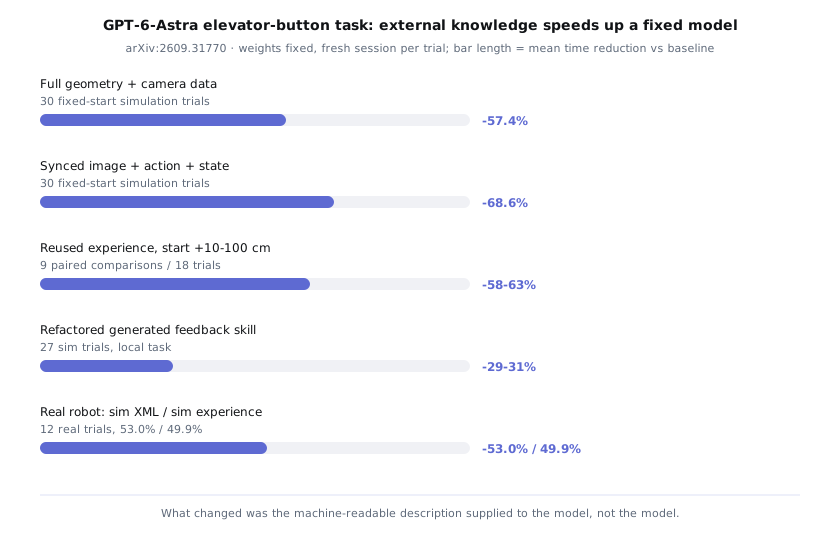
The model did not change; the knowledge supplied to it did. Five results from arXiv:2609.31770.
Our reading: this transfers directly to factories. Most industrial AI budgets go to model selection, yet this experiment produced a >50% difference in task time with weights untouched, purely by structuring body descriptions and successful experience. A factory's equivalent of a body description is the structure of its production system — its ontology.
3. NVIDIA moves automotive assembly into simulation
NVIDIA's own case study: Volkswagen Sachsen and Wandelbots combined the NOVA platform with NVIDIA Isaac Sim (built on Omniverse and OpenUSD) to program, simulate and validate robots in a physically accurate digital twin before deployment. The task is specific — roof liner assembly, a large, flexible part with tight tolerances, traditionally requiring weeks of manual iterative adjustment.
NVIDIA states that robot programming for complex manufacturing tasks went from weeks to minutes, and development time for new robotic assembly solutions from months to under a day. The same page carries a qualifier that must be quoted with it: the project was demonstrated at the Dresden Transparent Factory and is "not yet deployed in serial production". We do not present it as a production deployment.
Two further official examples: since GTC 2020, BMW Group has used the NVIDIA Isaac platform for five AI-enabled logistics robots, trained on both real data and GPU-rendered synthetic data and continuously tested in Isaac Sim; Hyundai Motor Group is building an Omniverse digital-twin factory and uses Isaac Sim to validate task allocation, motion planning and ergonomic safety before robots reach the physical line.
Together: when physical data is too expensive, generate it inside a high-fidelity description. That description is itself an ontology — vehicle, station, gripper, path, tolerance and timing must all be structured before simulation means anything.
4. Xiaomi's answer: solve where the data comes from
The third path is blunter: do not generate data, capture human experience efficiently. Two distinct Xiaomi efforts are often conflated in coverage:
- A tactile glove: with the March 2026 bionic-hand redesign, Xiaomi described collecting tactile data using a glove wearable by both a human hand and the robot hand — more efficient than teleoperation — and shaping the bionic hand close to 1:1 human scale to reduce transfer loss.
- UMI handheld rigs: a separate device. Xiaomi Robotics' project page states Xiaomi-Robotics-1 was pre-trained on over 100,000 hours of embodiment-free UMI trajectories across more than 1,700 scenarios, with over 7,200 hours of in-house real-robot data for post-training. A VLM segments long videos into clips and describes scene state transitions; the corpus was labeled in roughly two weeks. Paper: arXiv:2607.15330 (16 July 2026).
The glove line also has a strong primary source: TacRefineNet (arXiv:2509.25746, Xiaomi Robotics), tactile-only grasp refinement. It collected 156,007 simulated samples from 15 plates, discs and rods in MuJoCo, trained entirely in simulation, and deployed zero-shot to a real 11-DoF hand. Under a 10-degree/10 mm criterion, seen objects reached 80.7% and 59.3% success for fixed and random targets; after five steps, mean error was about 5.2 mm and 3.5 degrees. Another textbook sim2real result: model the contact, then transfer.
Stack the three: Astra supplies a structured description of the body, NVIDIA a high-fidelity description of the environment, Xiaomi structured capture of experience at scale. All three do the same thing — describe the world before handing it to a model.
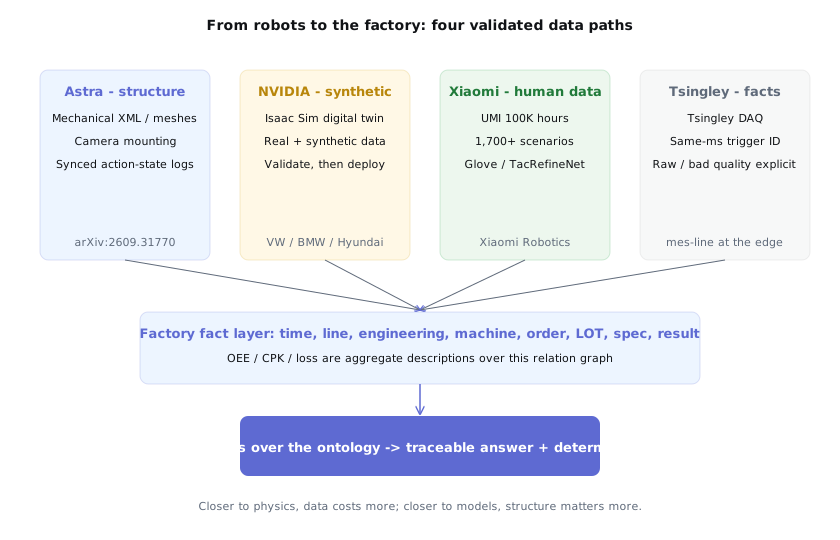
Description before intelligence: all four paths need a layer of reason-able facts underneath.
5. Back to the factory: the missing piece is not compute, it is facts
A robot needs a model of one machine or one room. A factory needs a model of an entire production system. The questions people actually ask are never "give me an OEE report":
- Which plant, when, which line, which machine?
- Which work order, lot, item, specification version, and process step?
- What was done, and what was the result (pass/fail, measured value, process curve)?
- What were OEE and CPK, what was the final output, and exactly where — which step, which machine — was the loss?
- What changes if we reschedule or switch the recipe?
All of these are about relations, not single values. OEE is not a record; it is an aggregate description of time, machine state, takt and yield. CPK is not a chart; it is a computed relation across item specs, lots, engineering steps, machines and time. Analysis is the act of describing data relations — reconnecting scattered facts along the right edges.
Without that layer, feeding factory data to a model produces fluent guesses. It cannot tell whether a drop in line 3's OEE came from a sub-healthy machine throttling down, a spec version change, or a cluster of NG parts in one lot. This is why so many manufacturing LLM projects stop at a question-answering demo: the model is not the bottleneck; the factory has not been described in a form a model can reason over.
6. ONLINE is that ontology — built for models
Tsingley ONLINE is the cloud / plant layer in the cloud-network-edge-device architecture. The conventional description lists ten management modules. Seen as something a model reads, the more precise definition is: the ontology of a factory's production system, and its working implementation.
| Ontology concept | Carried in ONLINE | Question it answers |
|---|---|---|
| Plant / line / engineering / machine | Equipment, line authorization, 3-level binding | Where |
| Time / work order / LOT | Production records, lot traceability | When, for which batch |
| Item / spec (versioned) | Item library, limits, version numbers | By what standard |
| Result / efficiency / capability | OK-NG records, OEE, CPK | How well |
"Built for models" does not mean adding a chat box. It means the first reader changed. People read dashboards; models read concepts and relations — drilling along plant → line → engineering → machine → work order → LOT → spec → inspection result, or tracing one NG back to a lot, a step and a machine. The user states a need in natural language; the model reasons over the ontology and returns the conclusion together with the evidence chain.
Six design points that decide whether reasoning is valid
These are our engineering conclusions, not findings of the external papers above:
- One time axis. Every relation depends on a shared time slice: all points in one acquisition share the same millisecond trigger ID, so records, judgments, OEE and CPK align. Misaligned time means wrong relations.
- Missing data must be explicit. Report raw values; mark failed reads as bad quality; never silently omit. Otherwise a model reads "not acquired" as "zero".
- Spec versions are semantic versions. The same measured value means different things under different limits. The ontology must carry version numbers, or a model will judge last year's lot by today's tolerance.
- Permissions belong to the ontology. The three role levels and per-line authorization are not only UI rules; they bound what a model may retrieve.
- Multi-plant aggregation is computable. Weighting progress by each line's planned volume makes "which plant" a queryable dimension instead of a vague group-level figure.
- Conclusions must be traceable; actions must be deterministic. A judgment has to click back to source records; when something must be done, it goes through a standard tool interface — natural at the entry, certain at the execution.
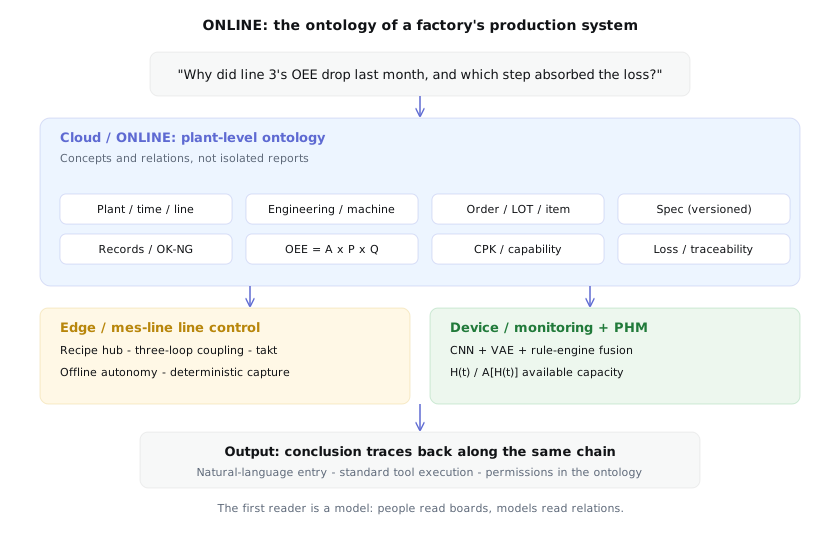
Natural language in, reasoning down the ontology, conclusions back along the same chain to source records.
7. Three-loop coupling describes the relations: a graph, not a table
Tsingley's MES II industrial IoT three-loop control model supplies the skeleton for those relations. It is not three reports, but three coupled loops:
- Device loop (seconds): PHM produces a health scalar H(t) and the available-capacity signal A[H(t)]; inline monitoring judges each weld or part as OK/NG with CNN + VAE + rule-engine fusion.
- Efficiency loop (minutes): mes-line executes recipes and work orders at the line, computing OEE = A x P x Q and CPK in real time, linking machine state, takt and yield into one explainable efficiency chain.
- Work-order loop (days): ONLINE integrates takt and efficiency at plant level into work-order progress and compares it against planned output. The governing equation W(t) = (1/W_plan) * integral of A(t) P(t) Q(t) Takt(t) dt is, literally, the three loops written as one data relation.
The word is coupling, not simple cascade: the topology is triangular, with a cross-loop direct channel between device and work-order loops — a machine fault can trigger work-order transfer directly, without waiting for the efficiency loop's OEE to drop first. Three regulation paths run in parallel: derivative (rate of change of H(t) for early warning), integral (progress deviation feeding back down), and cross-loop direct (event-level notification).
Why does "where and in which step was the loss" require a graph? Because OEE = A x P x Q is already a loss decomposition tree: investigate A along the device loop (health and downtime classification), P along the efficiency loop (takt and throttling), and Q along the three-path fusion judgment (which spec, which LOT, which step the NG clustered in). Asked "why did line 3's OEE fall last month", a model traverses this graph and returns a traceable causal chain, not a one-line guess.
8. Where MES II sits: others own planning, we own execution
Tsingley MES II has a consistent architectural stance: it does not replace the customer's existing MES/APS planning layer; it supplies the execution and feedback loops underneath it. The work-order loop's setpoint comes from external scheduling; Tsingley receives the task, executes control and reports the result.
Deployment is two-tier: ONLINE at plant level, one mes-line per production line, kept consistent by a sync engine but never mutually dependent at runtime — the line keeps producing with the network down and resumes incremental upload on recovery; Tsingley DAQ handles multi-protocol device access. This is exactly the physical prerequisite of a model-first system: deterministic acquisition at the edge, semantic aggregation at the plant layer, reasoning on top. Get acquisition and relations right first; deploying a model and back-filling data governance afterwards has the order reversed.
9. Closing: factory software changes — everything becomes a model
For decades factory software assumed one reader: a person. Software fixed processes into forms and people followed them; software drew reports and people analyzed them; software was a recording tool and judgment stayed in a human head. The computing paradigm has changed, and so has the reader. Once models participate in understanding, reasoning and dispatch, a system's core asset is no longer how many features or reports it has, but whether it holds a machine-reasonable description of the world.
| Dimension | Earlier factory software | After everything becomes a model |
|---|---|---|
| First reader | People: operator, engineer, plant manager | Models, then people |
| Data shape | Forms and reports, organized by screen | Ontology and relations, organized by fact |
| Interaction | Menus, query builders, Excel exports | State the need; the model reasons over relations |
| Core value | Keep the process under control | Describe the world so conclusions are traceable |
Astra's experiment, NVIDIA's simulated assembly line and Xiaomi's data capture are all, in essence, preparing a *world* for a model. In a running factory that world is: which plant, when, which line, which machine, what was done, what resulted, what OEE and CPK were, what the final output was, which step absorbed the loss — and every relation between them, tied together by the three-loop model.
ONLINE was produced by exactly this shift. It is not a legacy MES with an AI feature bolted on; from day one it treats the production system as an ontology to be read by models. People can still open a dashboard or export a file — but more importantly, when someone simply states what they need, the model knows which relations to follow.
References
All external case figures come from the primary sources below. The HomeBody project published no quantitative success rate and is used only as an architectural reference; no numbers are quoted from it.
[7] arXiv:2607.15330, Xiaomi-Robotics-1 (16 Jul 2026) — https://arxiv.org/abs/2607.15330
[8] arXiv:2509.25746, TacRefineNet (Xiaomi Robotics) — https://arxiv.org/abs/2509.25746