CNN classifies known faults but isn't explainable. VAE detects unknown anomalies but can't classify them. The rule engine is explainable but has limited coverage. Tri-fusion isn't about "more is better" — remove any one path, and you create blind spots.
What Does Sampling Actually Cost?
EV battery tab welding. One missed cold joint. An entire batch of cells could be scrapped. Yet most factories rely on sampling — pull a few per batch, do a pull test. If you're lucky, you catch the bad one. If not, it ships.
Why can't they do 100% inspection? A single weld takes 50-200ms. Human visual inspection can't keep up. Post-weld tests (pull strength, metallography) are destructive — test one, destroy one. To inspect every weld, you have to judge it during the weld itself, from the signal.
Tsingley's inline monitoring acquires 4 analog channels (power/amplitude/frequency/pressure) at 10 KHz — 2000 data points per weld — and delivers a verdict within 200ms. No sampling. Every weld judged.
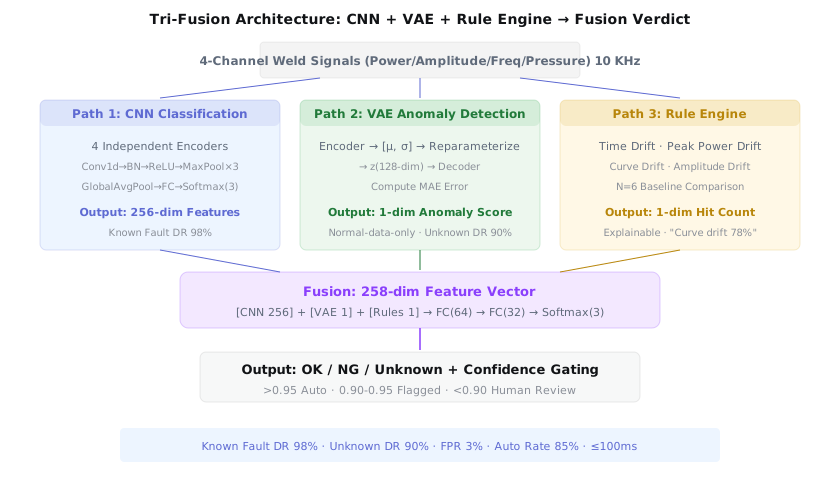
Three parallel paths: CNN classifies known faults → VAE detects unknown anomalies → Rule engine provides explainable metrics → 258-dim fusion → OK/NG/unknown + confidence gating
Why Can't You Just Use One CNN?
A standalone CNN can tell you "normal" or "abnormal" or "uncertain" — but not why. The operator sees "uncertain" and has no idea whether power drifted or amplitude is off. Worse: when a fault type never seen in training appears, the CNN confidently gives a wrong classification.
Add a VAE: trained only on normal welds, it has never seen any fault. When a genuinely new fault pattern appears, the VAE's reconstruction error spikes. It can't tell you what the fault is — but it knows something is wrong.
Add a rule engine: weld time, peak power, power curve shape, ultrasonic amplitude — four metrics compared against the last 6 welds as baseline. Outputs exact drift percentages ("Power curve drift 78%"). Operators understand it instantly.
Tri-Fusion Isn't Addition. It's Interlock.
CNN 256-dim features + VAE 1-dim reconstruction error + Rules 1-dim hit count = 258-dim fusion vector. Two FC layers merge them into a final verdict. Confidence >0.95: auto. 0.90-0.95: flagged for spot-check. <0.90: routed to human review.
Known-fault detection: 98%. Unknown anomaly detection: 90%. False positive rate: 3%. Auto-verdict rate: 85%. This isn't "take the max of three outputs" — it's three paths correcting each other.
Deterministic Transport: Incomplete Data Is Worse Than No Data
Traditional data transmission has a fatal flaw: data is sent before it's fully assembled. The inference engine receives a partial weld signal and produces a wrong verdict.
Deterministic transport: weld completes → all 4 channels packaged → assembled into an inference window → integrity verified → dispatched at a designated time slot. Incomplete? Discarded, re-requested. The inference engine always gets complete data.

Pipeline: Welder-synced trigger → 4ch 10KHz → per-weld packaging → window assembly → integrity check → scheduled NPU dispatch
INT8 for CNN. INT16 for VAE.
The RK3588 NPU has 6 TOPS. It needs to run CNN + VAE + fusion simultaneously. CNN classification tolerates precision loss — INT8 quantization works because BatchNorm absorbs the error. VAE must compute reconstruction error precisely — if quantization noise inflates the error, normal welds get flagged as anomalies. So VAE stays at INT16. Fusion layer: INT8. Rule engine: CPU. Total inference: under 100ms.
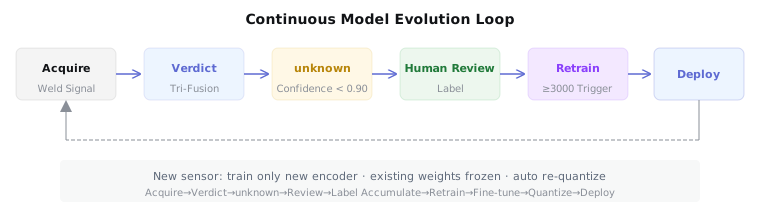
Closed loop: unknown → human review & label → accumulate 3000 samples → retrain CNN+VAE → auto re-quantize → deploy. The model gets better over time.
From a 200ms Verdict to a Continuously Improving System
Acquire → Verdict → Review → Label → Train → Quantize → Deploy. It's not a one-time delivery. Every "uncertain" verdict becomes training data. Every batch of accumulated samples triggers automatic retraining and quantization. The model adapts to the specific signal characteristics of each production line rather than degrading from environmental drift.