Early industrial software was built on mathematics: given variables and formulas, compute faster and more accurately. In the new digital factory the first question moves one level up - what actually exists in a plant, who is allowed to define it, and how definitions are shared and certified. Starting from Gruber's 1993 definition of ontology, this article argues that this is an engineering appropriation of philosophical ontology, not a replacement for mathematics, and states four verifiable product claims built on Tsingley's three-level data model, three-loop control equation and certified ONLINE definitions.
One-line overview
The advance of next-generation factory software is not a stronger algorithm. It is an answer to an earlier question: what counts as existing in this plant. Mathematics is not replaced - control equations, OEE and CPK remain - but they move from calculations scattered across code to objects that are registered, certified and traceable. Ontology here is not a mystical label; it is the engineering discipline of writing down what exists, how things relate and who may define them, in a form machines can consume.
1. Two eras, two first questions
Early industrial software was a system of mathematical algorithms. Given variables, constraints and an objective, the work was solving: stabilising a control loop, estimating a statistic, optimising a schedule, classifying a curve. Tsingley's own path started here - 1D-CNN, VAE, TCN, Wiener processes and particle filters in monitoring and PHM, plus INT8 / INT16 mixed-precision quantisation on an RK3588 NPU to bring inference inside a millisecond-scale weld cycle. That remains the product's foundation.
But once models become the first consumers of data, an earlier question appears: are the yield, work order, machine and process step inside those formulas the same things across systems? Mathematics cannot answer, because it only starts working after a domain has been defined.
| Dimension | Mathematics-centred software | Ontology-first software |
|---|---|---|
| First question | Given definitions, how to compute faster and better | What the definition is, and who approved it |
| Core asset | Algorithms, formulas, solvers | Concepts, relations, definitions, certification state |
| Typical output | Control equations, CPK, scheduling, reports | Domain ontology, glossary, certified expressions, lineage |
| Failure mode | Wrong or slow computation | Both sides compute correctly but disagree |
This must be stated plainly: it is a new layer, not a replacement. Algorithms run perfectly well without an ontology; with one, their inputs and outputs acquire stable identities. Claiming that mathematics is obsolete would be both factually wrong and fatal to the argument.
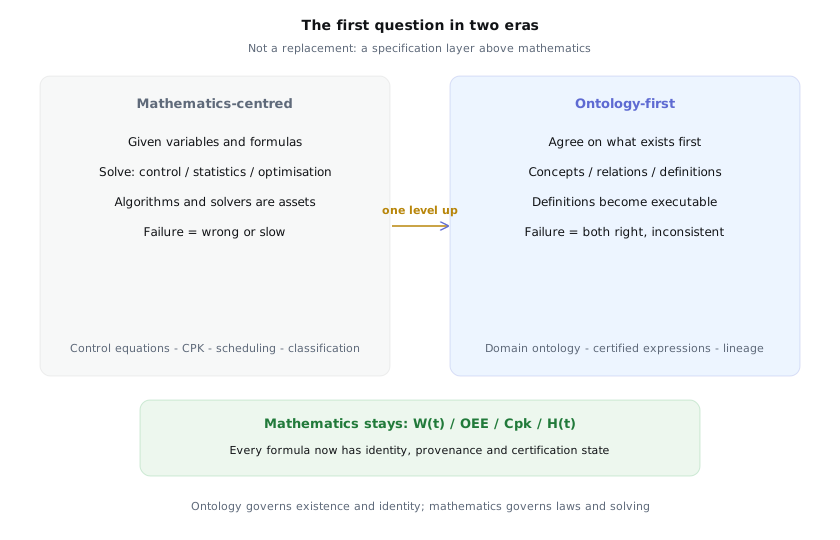
Mathematics is not replaced; specifying the world before solving it becomes the new first question.
2. Where the word Ontology comes from
In philosophy, ontology is the study of existence - a branch of metaphysics asking what kinds of things exist and which categories are fundamental. From the 1970s, AI borrowed the term: knowledge systems need a shared vocabulary before knowledge can be reused.
In 1993 Tom Gruber published the widely cited technical definition in *A Translation Approach to Portable Ontology Specifications*:
An ontology is an explicit specification of a conceptualization. The term is borrowed from philosophy, where an ontology is a systematic account of Existence. For knowledge-based systems, what "exists" is exactly that which can be represented.
The last sentence carries this whole article: for a knowledge-based system, what exists is exactly what can be represented. In a factory, a process step, a batch or a loss that never enters the ontology does not exist for an agent, and no amount of reasoning can reach it. Some researchers have called computational ontology a form of applied philosophy - but precisely, this is borrowing philosophy's question and engineering it through formal specification, not turning software into metaphysics.
3. Why the new digital factory cannot skip this layer
The three most common conflicts in a plant are not computation errors:
- Same name, different meaning: yield means first-pass yield in one system and final-inspection yield in another, with different denominators.
- Same meaning, different names: pass rate, yield, first-pass yield and rolled throughput yield are used interchangeably in conversation and land in different columns.
- Cross-level ownership: one number belongs to a plant, a line, a process step and a lot - and each system records that differently.
Mathematics cannot arbitrate any of these, because the domain has not been fixed, so no equation can be written. Historically engineers aligned them verbally or in documents; when the querier changes from a person to a model, verbal alignment stops working. An ontology writes down what exists and what counts as the same thing, explicitly enough for a program to execute.
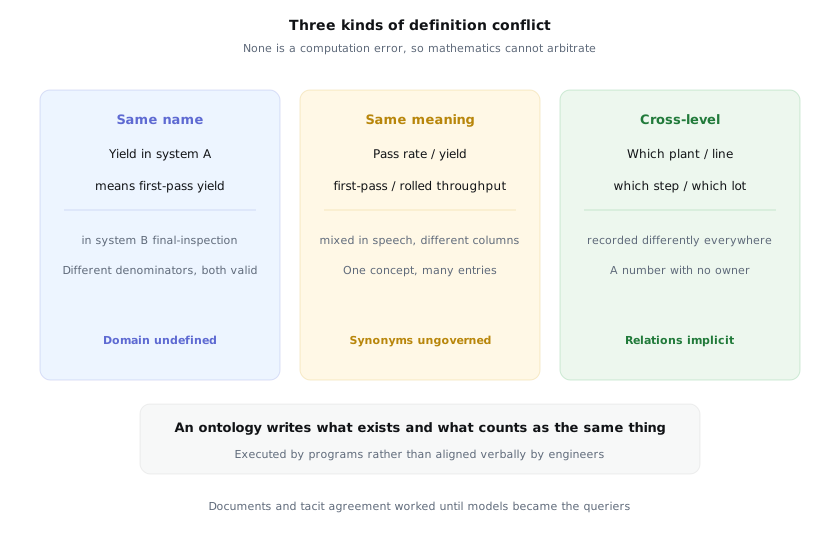
None of these conflicts is a computation error; mathematics cannot arbitrate an undefined domain.
4. Tsingley's ontological skeleton
Viewed through this lens, the product architecture was never an AI feature bolted on later:
| Question | Tsingley carrier | Nature |
|---|---|---|
| What exists | Three-level data model: line - engineering step - device (unique ID) | Stated in an architecture claim of patent 1 |
| How things relate and change | Three-loop coupling model: device loop H(t) / efficiency loop OEE / work-order loop W(t), with triangular coupling and a cross-loop direct channel | Relations and constraints |
| What counts as a valid calculation | W(t) = (1/W_plan) x integral of A.P.Q.Takt dt; OEE = A x P x Q; Cpk; the available-capacity signal A[H(t)] | Mathematical layer, registered as ontological objects |
| Where evidence comes from | Tsingley DAQ multi-protocol acquisition, mes-line line control, three-path fusion monitoring, PHM health scores | Observations of what exists |
This is exactly the precise claim: the governing equation remains a pure integral relation, but it now has an identity - which loop it belongs to, which metric it serves, who certified it, and which line and process step each result traces back to. Mathematics supplies the laws; ontology registers them.
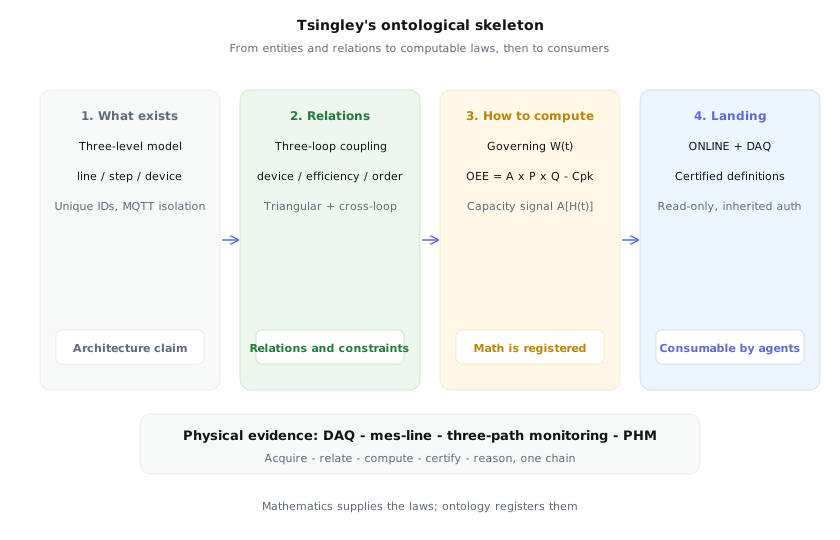
The three-level model states what exists, the three-loop model states relations, and the equations state computable laws.
The ONLINE data platform is where these conventions are made concrete: business terms, column mappings and OEE / CPK expressions are consolidated into governed definitions, opened to agents only after human certification; every answer carries SQL, mappings and certification status (provenance); queries go through read-only interfaces and inherit the signed-in user's permissions. As a reference point, NVIDIA's open-source auto-ontology (November 2026) follows a similar pattern: Discover / Ground / Validate / Expose / Learn, nine read-only MCP tools, and deliberately no raw-schema browser. Both paths make the same point - the value of an ontology layer is not model size but whether definitions can be certified and traced.
5. Stating product advantage in verifiable terms
Product messaging tends to accumulate adjectives. A sounder approach is to state claims a customer can test on site, with an explicit comparison:
| Verifiable claim | Meaning | Traditional reporting / single-tier MES |
|---|---|---|
| Answerable | Before querying, judge whether the ontology covers the question | Often returns an empty set or a guessed SQL |
| Traceable | Each number carries SQL, mappings and certification state | Only the result; definitions live in memory |
| Inheritable | Agent permissions equal the signed-in user's, never broader | Endpoint-level auth with fuzzy semantic boundaries |
| Evolvable | Definition changes go through certification and feed back into the ontology | Code or spreadsheet edits; historical definitions drift |
None of these depends on unfalsifiable claims about a smarter AI. A customer can test them against the metrics they ask about most often. That is the step that turns a philosophical proposition into product language.
6. Limits and restraint
- Ontology does not replace mathematics: control, statistics and optimisation remain in the execution layer; ontology governs the domain and identity.
- Ontology does not fix data quality: missing readings, inconsistent units and misaligned timestamps still need their own quality work - a model reads not acquired as zero.
- Generated is not approved: compiled terms and expressions are drafts and only gain governance after engineer certification.
- The ecosystem is young: related open frameworks are early-stage, best treated as design references and pilot tools; semantic assets should stay in your own store rather than being locked into one implementation.
7. Closing: the maturity marker changed
Factory software used to be judged by algorithmic strength, speed and report coverage. That standard is not obsolete, but it is no longer sufficient. Once models read data and make judgments on people's behalf, software must first state what exists in this world, how things relate and which definition was approved.
That is what it means for ontology to move from philosophy into the new digital factory: not a mystical coating on software, but turning the most basic matter - existence - from human tacit agreement into an explicit system specification. Mathematics still computes steadily underneath; from now on, every number it produces has a provenance.
References
Statements about the definition and philosophical roots of ontology follow Gruber's 1993 paper. Product facts come from Tsingley's published technical material and previously published articles; no unpublished patent numbers are used.